

Aleatoria (2010)
Peggy was bitten by the Nuit Blanche bug early! After creating move in 2009, she followed up the next year with a new, all-night durational work, Aleatoria.
Peggy writes: Debashis Sinha was my Musical Director for the premiere of move at Nuit Blanche, and he had brought in some other improvising musicians who all played together, switching off as to who was leading. Phil Strong, Ben Grossman and John Gzowski joined Deb, and the shifts in the sonic environment throughout the 12 performances between 7pm and 7am offered tremendous support and stimulation to the performers.
Ben gifted each of us involved in move with his new double CD release, Aleatoric Solo Duets for Electro-Acoustic Hurdy Gurdy. The two CDs were designed to be played simultaneously with each CD player set to shuffle so that the tracks – which were varying lengths – constantly recombined. I LOVED this concept as a premise for a durational dance and immediately beginning planning for Nuit blanche 2010.
I brought together 11 dancers who had been involved in past performances of my work and asked them to call up any movement memories they carried from those dances and to use them as the basis for improvised episodes that would last 10 minutes. ‘Aleatoric’ means randomly or by chance and taking that invitation we used a chance procedure to determine the order of dancers each hour. The 12-hour performance began with a single dancer who was joined by a second dancer after 5 minutes and replaced by a third dancer at the 10-minute mark and so on and so on throughout the night. I joined Kate Alton, Nova Bhattacharya, Sylvain Brochu, Sarah Fregeau, David Houle, Sasha Ivanochko, Sean Ling, Sahara Morimoto, Andrea Nann, Jessica Runge, and Brodie Stevenson – each of us dancing as soloists but also spontaneously creating duets with one another to Ben’s gorgeous music as it spun out over the hours.
Find out more about the hurdy gurdy here on YouTube.
Film-maker Midi Onodera captured time-lapse movies. You can watch them here on her website.


armour (2007/2010)
The final piece in Peggy’s watershed program Confluence at Harbourfront Centre in 2010 was a reworking of a Doug Varone piece, his fourth to be acquired for the company’s repertoire. Peggy writes:
In 2007 I was included in the cast of a full evening work with Doug Varone and Dancers titled Dense Terrain. This was a hugely ambitious project including 12 performers, projections, sets, and original music by Nathan Larson. One of the early influences on the work was The Lives of a Cell, a book by Louis Thomas published in 1974, and read by both Doug and I – and so many others of our generation – at the time. Many of the essays in this book focused on social insects, and a fascinating duet in Dense Terrain for Natalie Desch and Daniel Charon held a strong imprint of that source material.
I totally loved that duet! And I no longer remember if I asked Doug if I could learn it, or if he suggested it himself, but certainly it was beautifully aligned with my dances inspired by Sylvia Safdie’s films of insects, and by bringing it together with my solo earthling and the trio coalesce, it created a wonderful program. Taking the duet outside the context of Dense Terrain, Doug allowed me to commission sound design by Debashis Sinha (who had also scored earthling and coalesce) and titled this version of his dance armour.
Deb’s score supported every aspect of the dance, enriching the impact and significance of each action, while Marc Parent’s exquisite lighting required Larry and I to be spatially exacting with every single move.
Visual artist Brian Kelley sketched, and later completed with water colour, a beautiful series of small works capturing this brief and perfect dance.
“It is the being touched that counts, rather than the touching.” Lewis Thomas, The Lives of a Cell
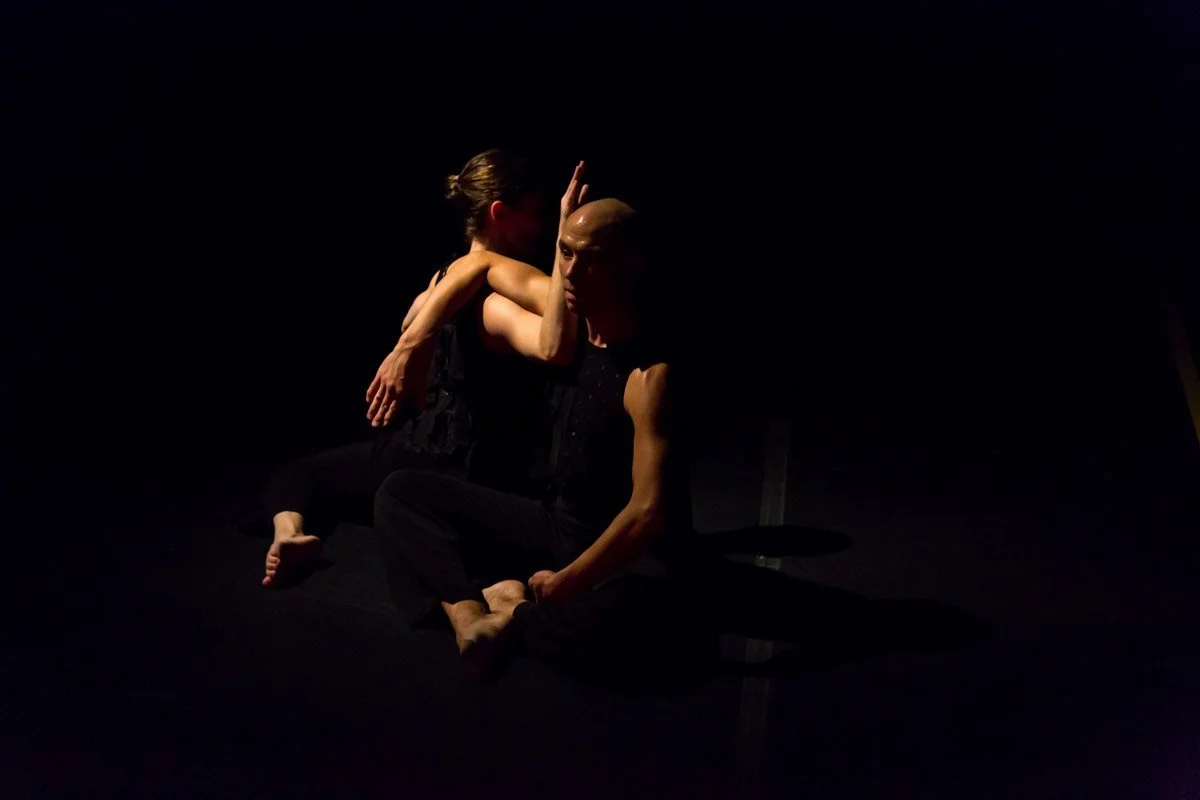
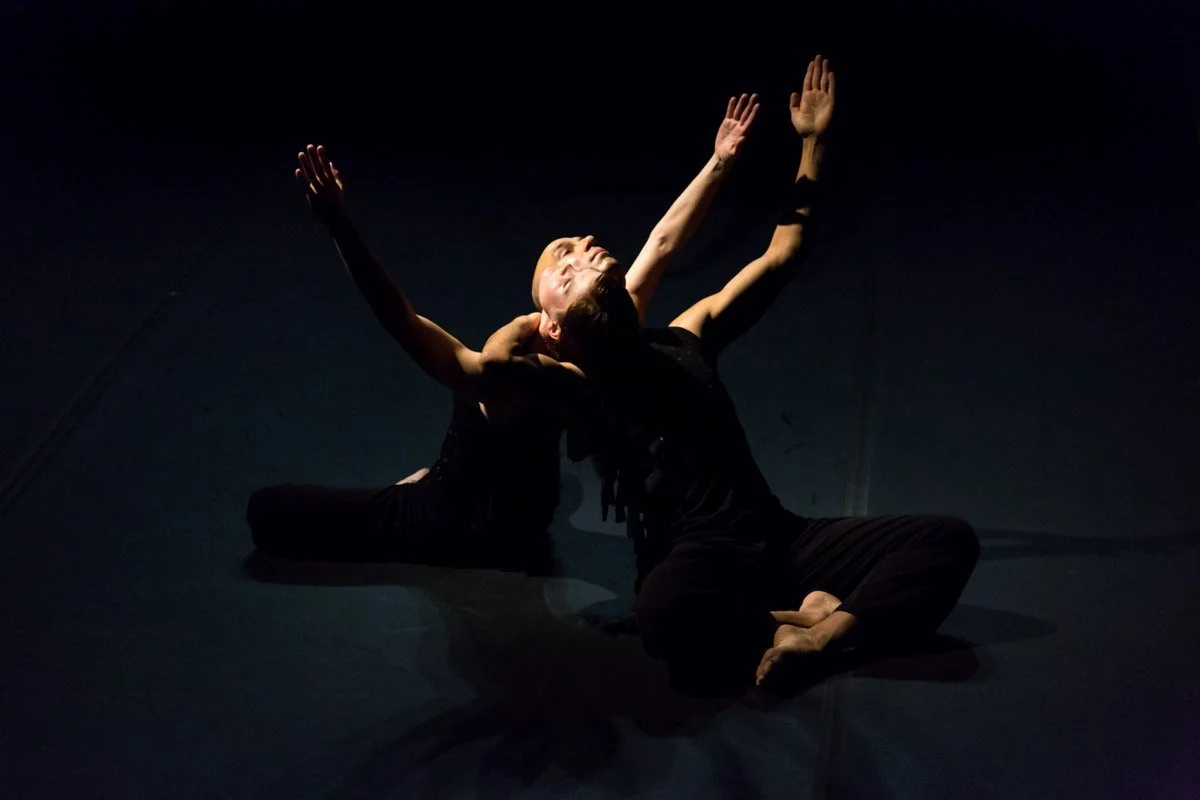
“Baker and Hahn are here more like archetypes, elemental and distilled representations of the human need for connection beyond the stereotypical, emotionally overcharged and romantic dance duets we’re used to seeing. They insinuate themselves into each other’s embrace, isolated yet together, driven by forces more mysterious than they can apprehend.” - Michael Crabb, The Toronto Star
“…as Mr. Sinha’s music slowly built what emerged was an intimate, human portrait. Remaining on the floor the dancers cycled through interlocking embraces. Their bodies fit like an endlessly mutable jigsaw puzzle: a universe of two.” Julia Cervantes, The New York Times


coalesce (2010)
coalesce is Peggy’s first ensemble work to be included in her company’s main stage programming. It premiered in Toronto in a concert titled Confluence, presented at EnWave - now Harbourfront Centre Theatre.
Peggy writes: After 20 years of making solos for myself, I was extremely curious about what might happen if I engaged in a creative process with a small group of dancers. I thought that a trio would be within reach for me and brought together as the cast three dancers I deeply admired – Kate Holden, Sean Ling and Sahara Morimoto. I had used one of Sylvia Safdie’s films as a foundational resource for my solo earthling, but there were several others of two insects together and of whole groups of insects that were also fascinating, so I started there.
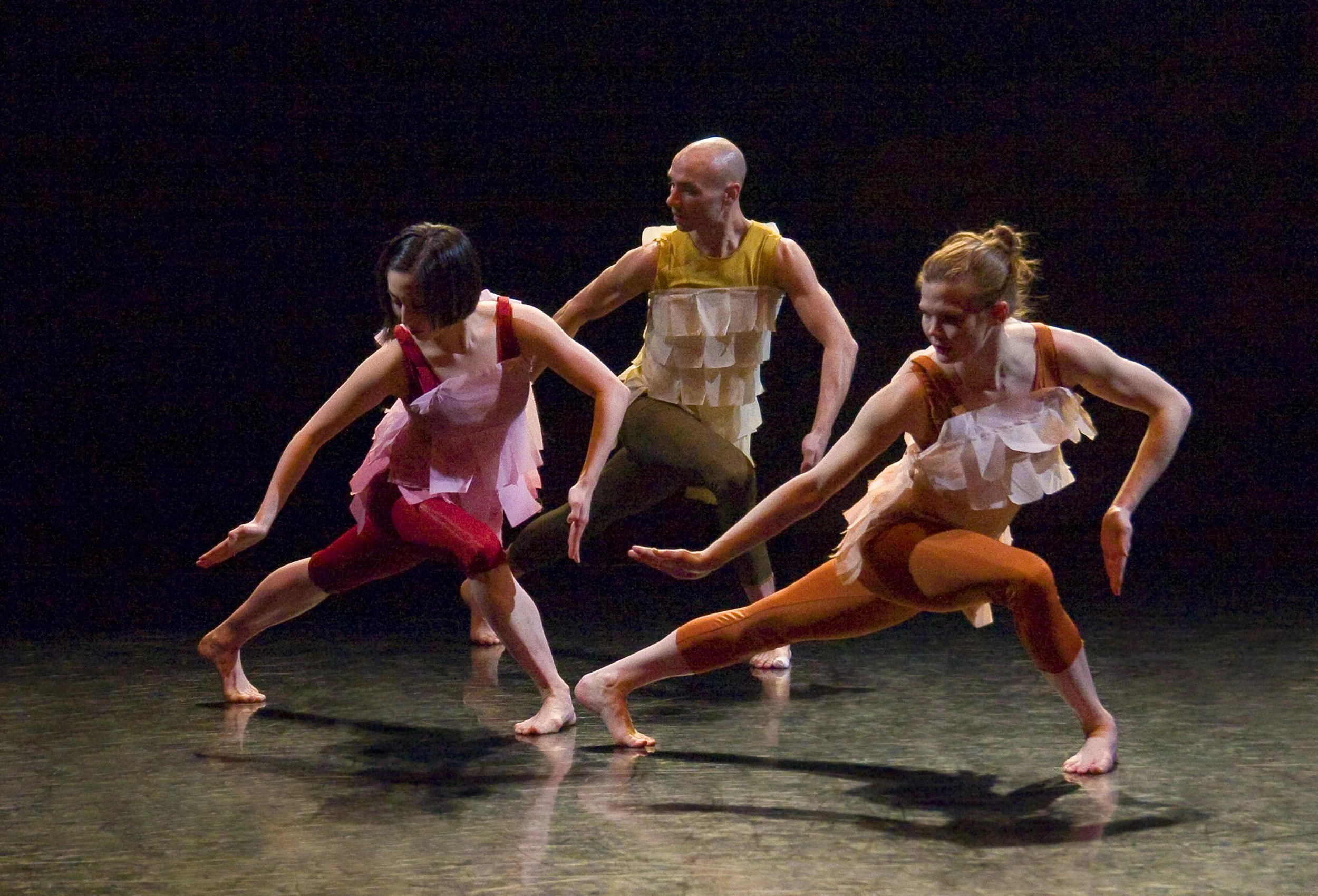
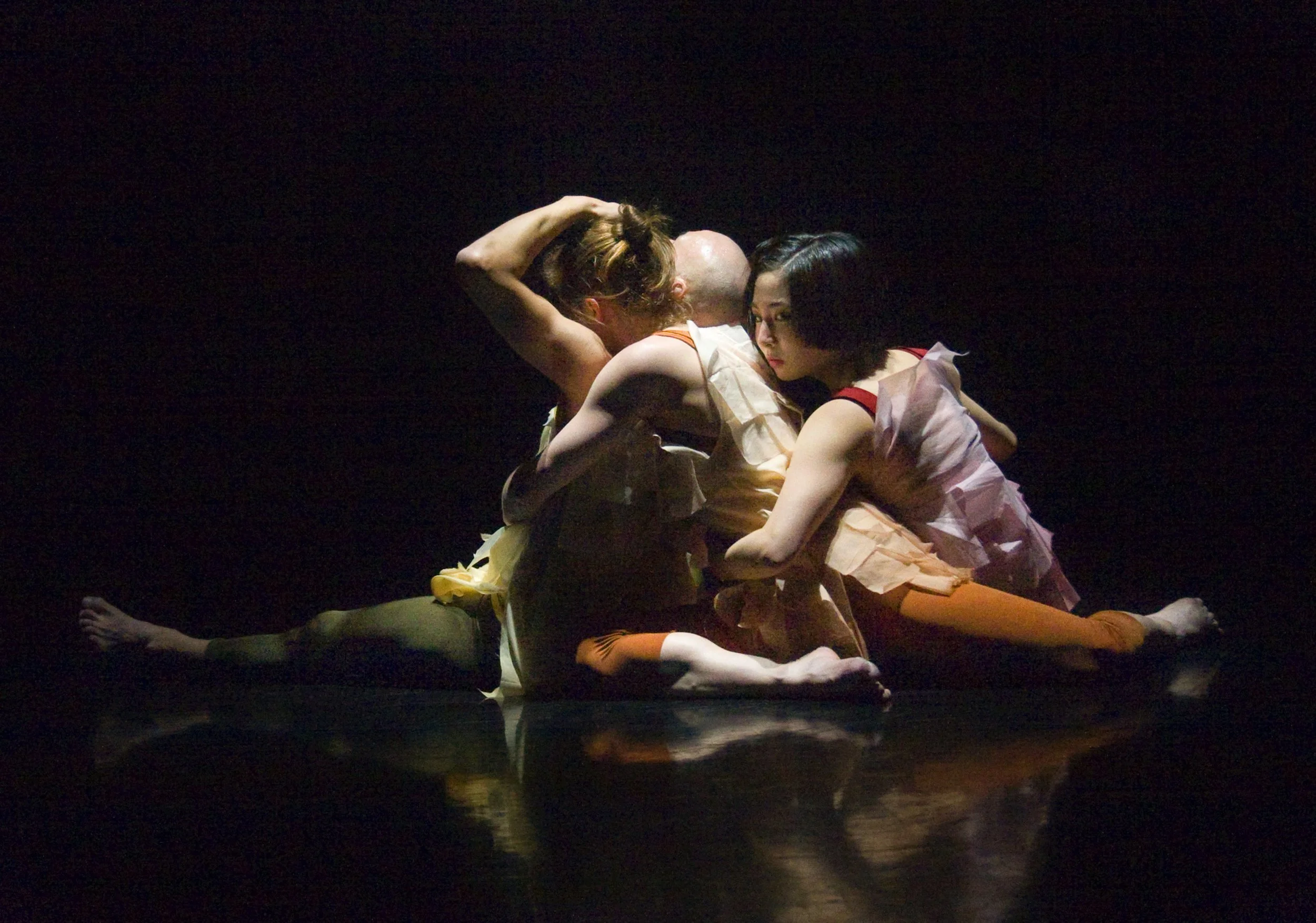
The dancers and I dug in to learning about communication among insects via pheromones, and played with movement patterns inspired by the many insect appendages including 3 sets of limbs, antennae, wings and mandibles. A very particular sensibility arose by shifting concepts around sensory discernment and by working with the idea of an exoskeleton – a hard, brittle exterior. The trio that arose was highly stylized and absolutely fascinating to watch.
Debashis Sinha was present in the studio with us, sitting at his computer and wearing a set of headphones so that he could develop the sound design parallel to the emergence of the choreography. It did take me some time to land on the proper costuming, but in staging an excerpt of coalesce for the graduating class at The School of Toronto Dance Theatre, Jennifer Dallas created a fantastic set of costumes and I turned to her to make a new set for my company using the same design.
I took intense pleasure in creating this dance with Kate, Sean, Sahara, and in the new ways of working that arose with Deb and with lighting designer Marc Parent. I knew without a doubt that I had found a way forward beyond making and performing solos, and I moved eagerly into a new phase in my dance life. PB
“Baker's new program indeed transports us to an otherworldly place beyond conventional human experience.” Read more from Michael Crabb’s review in The Toronto Star
The dancer and the insect expert is an article about the involvement of Dr. Darryl Gywnne, a behavioural ecologist and professor of biology at U of T Mississauga in Peggy’s presentaton of Confluence.


move (2009)
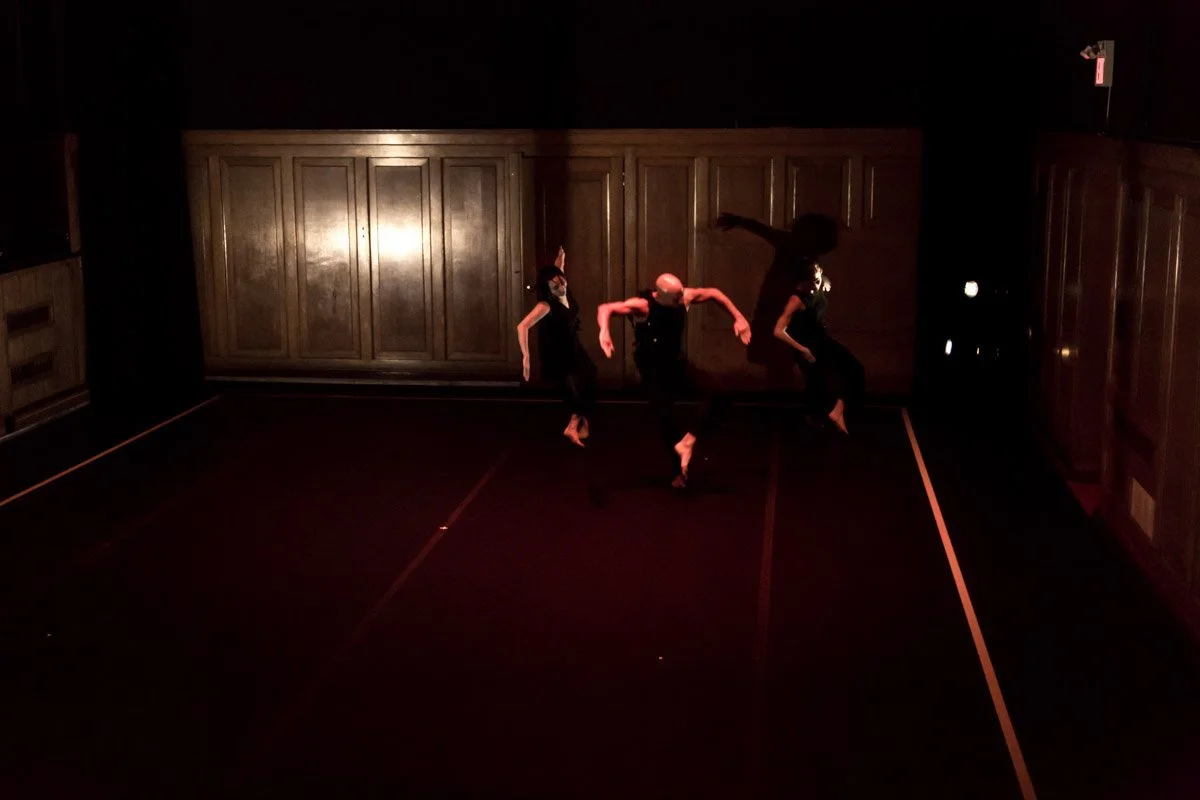
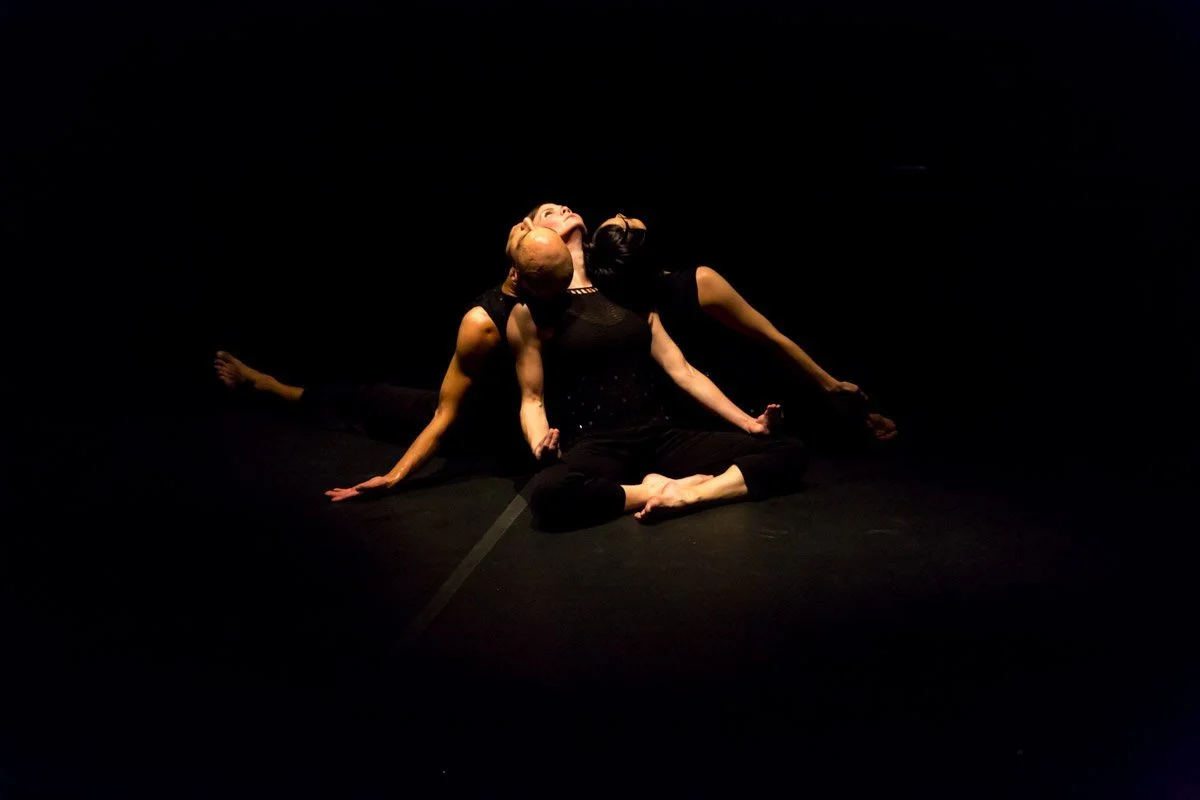
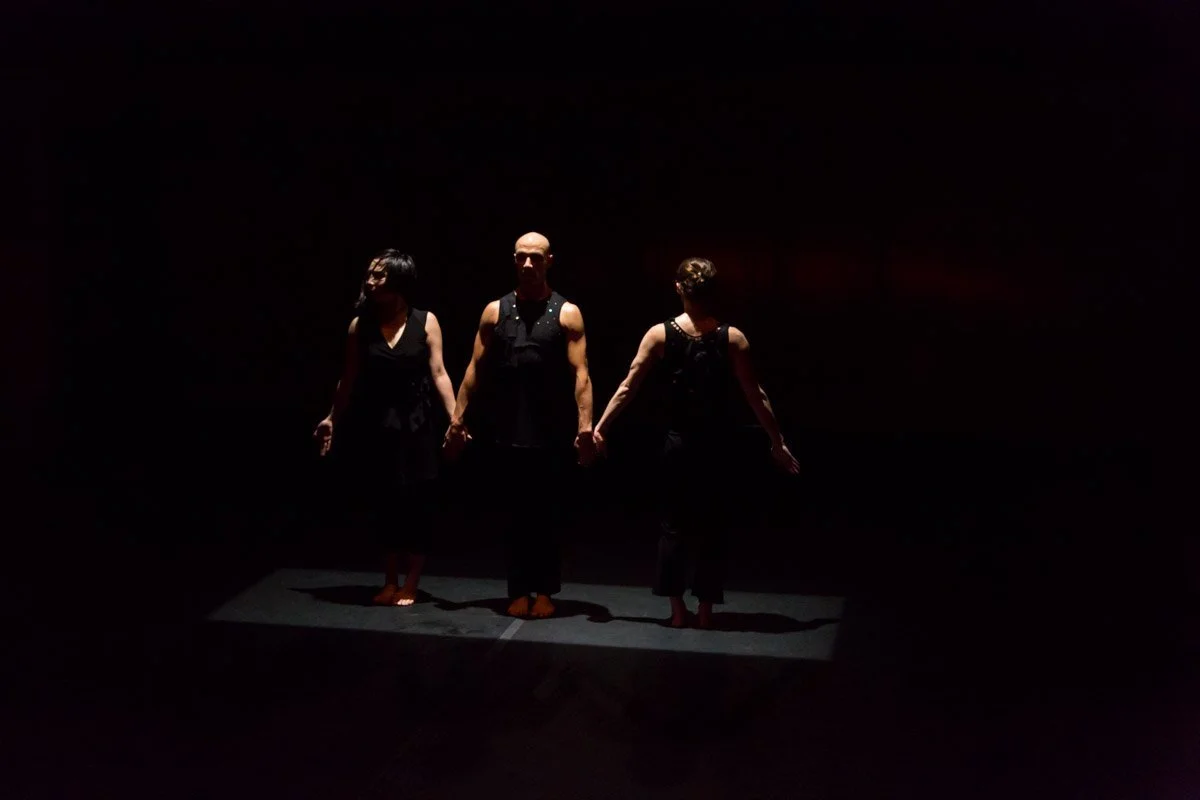
Created in 2009 for 24 dancers, and premiered as part of Toronto’s annual all-night contemporary art event, Nuit Blanche, move was a harbinger of a fundamental change in focus and programming for the coming decade for Peggy Baker Dance Projects. From 2010, Peggy’s role increasingly moved away from that of principal dancer in a solo-repertoire company to that of Artistic Director of Peggy Baker Dance Projects, and the choreographer of the company’s new ensemble works. She began to embed public engagement in the company’s projects by finding new ways of presenting work in alternative spaces, and by inviting community members to take part in her works.
Peggy writes: Between 2007 and 2011 I did five teaching residencies in Philadelphia sponsored by the Pew Charitable Trusts’ Dance Advance, headed at that time by Bill Bissell. My very first residency took place in the studios of PHILADANCO!, a Black dance company with a storied history, and it was incredible to move through the halllways lined with photographs of the dancers going back through every generation of the company, and to work in the studios where the company’s classes and rehearsals took place.
One of the opening elements in the class I was teaching then was the ‘crescent roll’, a fundamental exercise devised by Steve Paxton as preparatory movement practice for Contact Improvisation. The rolling action across the floor requires both strength and suppleness and at first the underlying pattern can be confusing. To work through the confusion of coordination and direction I had the dancers working in pairs, with one dancer gently but firmly guiding the other through the twisting roll. The interaction looked extremely beautiful and as the dancers changed roles for each pass across the studio, I was struck by the powerful images of giving and receiving care that emerged. Added to the potency of witnessing this was the gorgeous sonic environment being created by the musician for my classes, guitarist Tim Motzer. On this same trip I happened to take in a retrospective exhibition of works by George Tooker that included images of couples embracing, of people asleep, and of men reclining sand dunes. The curving pathways of the dunes also brought to mind the raked gravel or sand of Zen dry gardens, and the patient work of the dancers rolling one another in the studio seemed to align somehow for me with the mindful practice of monk’s raking.
All of these images and associations came together for me as a very clear and rich premise for a durational work for a large cast that distills and illuminates the fundamental dualities of:
- touching and being touched / a basic modality for caregiving and receiving care, and for teaching and learning in dance
- watching and being witnessed / the essential relationship between teacher and student, audience and performer, and of dancers together in class, rehearsal, performance
- movement through the body and that same body’s movement through space
The work premiered in Toronto for Nuit Blanche 2009 danced by a cast of 12 couples. For performances at the Art Gallery of Ontario in 2011, I reduced the cast to 8 couples, who danced in a cycle of four repetitions, with the front rotating by 90 degrees and each dancer changing roles with their partner for each iteration. This version has now been staged many times – presented in galleries and public spaces in St Catharines, Kingston, Burlington, Hamilton, Fredericton and Calgary – danced by professional dancers and by community members. - PB
To read more about move from the perspective of a community participant, Andrea Frolic wrote a beautiful article for The Dance Current in 2019 entitled The Ecologies of Care after taking part in the staging of the work with the Art Gallery of Hamilton.


earthling (2009)
This week we’re looking at a work that was created for Vancouver’s legendary Dances for a Small Stage series, curated by Day Helesic and Julie-anne Saroyan. Peggy made this solo on and for herself, mining what would become a rich vien of movement invention inspired by a gift from Montreal visual artist, Sylvia Safdie.
Peggy writes: Throughout the 1980s I made regular visits to Montreal to teach classes and lead intensive workshops at Les Ateliers de Danse Moderne de Montreal, an ambitious training program established by Linda Rabin – one of the most influential teachers in my own life – and Candice Loubert. While I was in town, Linda always made a point of taking me to the studio of her great friend, the visual artist Sylvia Safdie, so that I could see Sylvia’s latest work and hear about the preoccupations that were driving it. Over the course of more than 20 years I was privileged with a rare view of the arc of Sylvia’s work. On a visit in 2007, Sylvia showed me a series of films of she’d recently done and shocked me completely by offering one of these to me as a possible premise for a dance. The film was a close-up of a beetle on its back, in its death throes. Sylvia had worked choreographically with the footage, slowing it down, creating repeated loops and reversals of action. I found the film both sorrowful and exquisite. I had no idea how I might approach it, but I accepted her gift in all humility.
That same year I happened to made a trip to Dia Beacon, where I encountered – among a multitude of deeply affecting works – a series of large plywood “boxes” by Donald Judd. These objects were cubes, closed on all sides, but with the top set part way down into the interior, tipped in one direction and tilted in the other, and with the complex angles of each edge perfectly fitted into the sides. Looking down into the box I felt as though I was looking at a maquette of a stage gone wildly awry and with the proscenium providing a view from above rather than from the front.
I had images from Sylvia’s beetle and Donald Judd’s boxes rattling around in my head when I got an invitation from Day Helesic and Julie-anne Saroyan to present a work for Dances for a Small Stage in Vancouver. The venue was a Legion Hall on Commercial Drive with a stage that was truly and remarkably small. Riffing on Judd’s boxes, I immediately thought of this as the perfect opportunity to install a tilted and tipped floor that would fill the entire stage. Putting myself down onto this surface without ever getting up on my feet created the illusion that the audience was looking down on me, and this possibility sparked the idea of working with movement ideas related to Sylvia’s beetle.
Larry Hahn created a fantastic floor for me, supported by a substructure of struts, and I painted the surface in a way that I thought suited the world of the struggling creature that I had stranded on its surface.
Everything alive on earth is caught up in the cycle of birth and growth and death that is also a source of renewal and transformation. PB
To explore Sylvia Safdie’s most recent exhibition As I Walk, visit YouTube here.
Watch Peggy’s 2020 short, Influences and Intersections - Donal Judd and Sylvia Safdie to discover more about earthing.


In the Fire of Conflict (2008)
Wow, 2008 was a busy year!! This week we’re looking at the 5th work to premiere in 2008, In the Fire of Conflict.
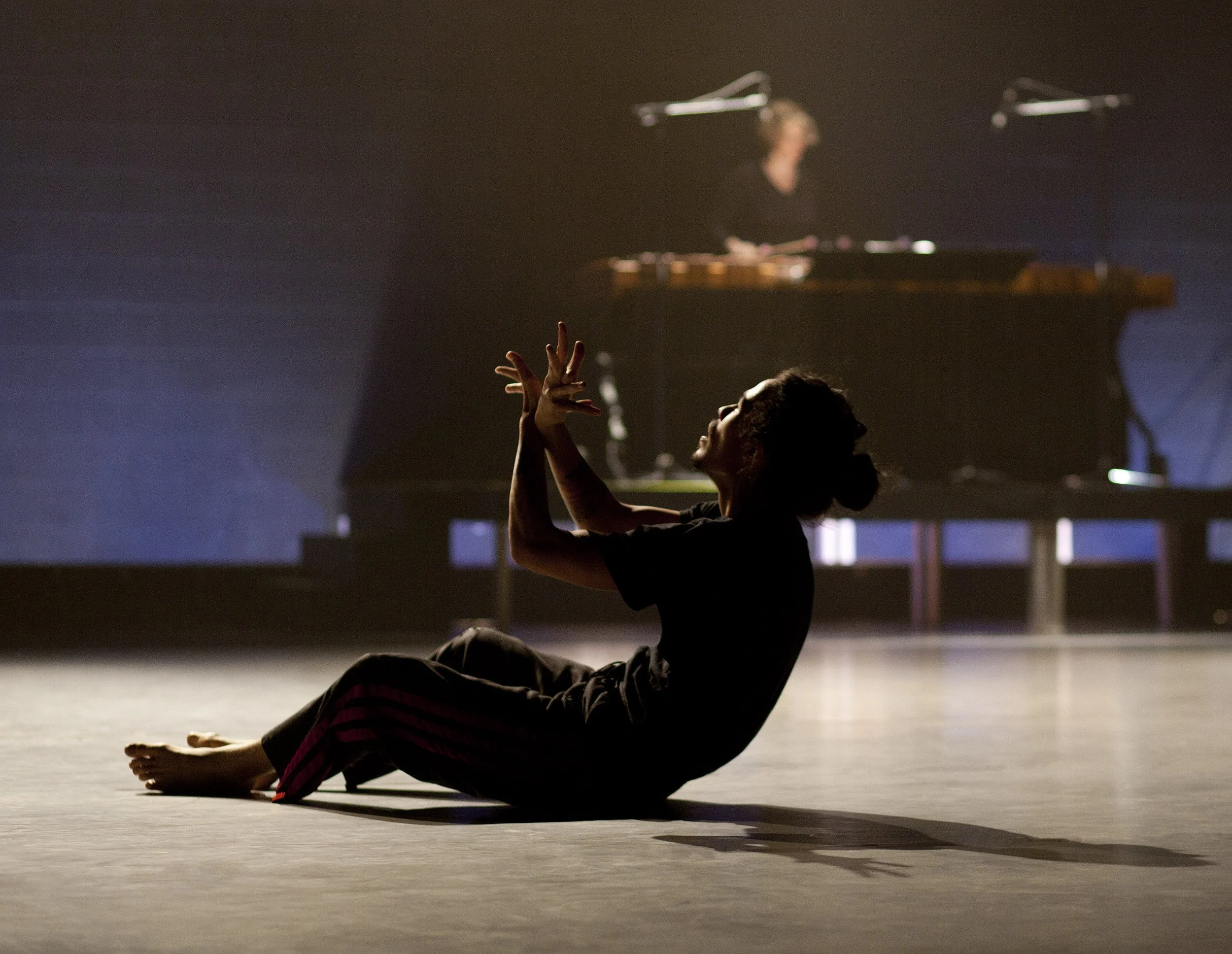
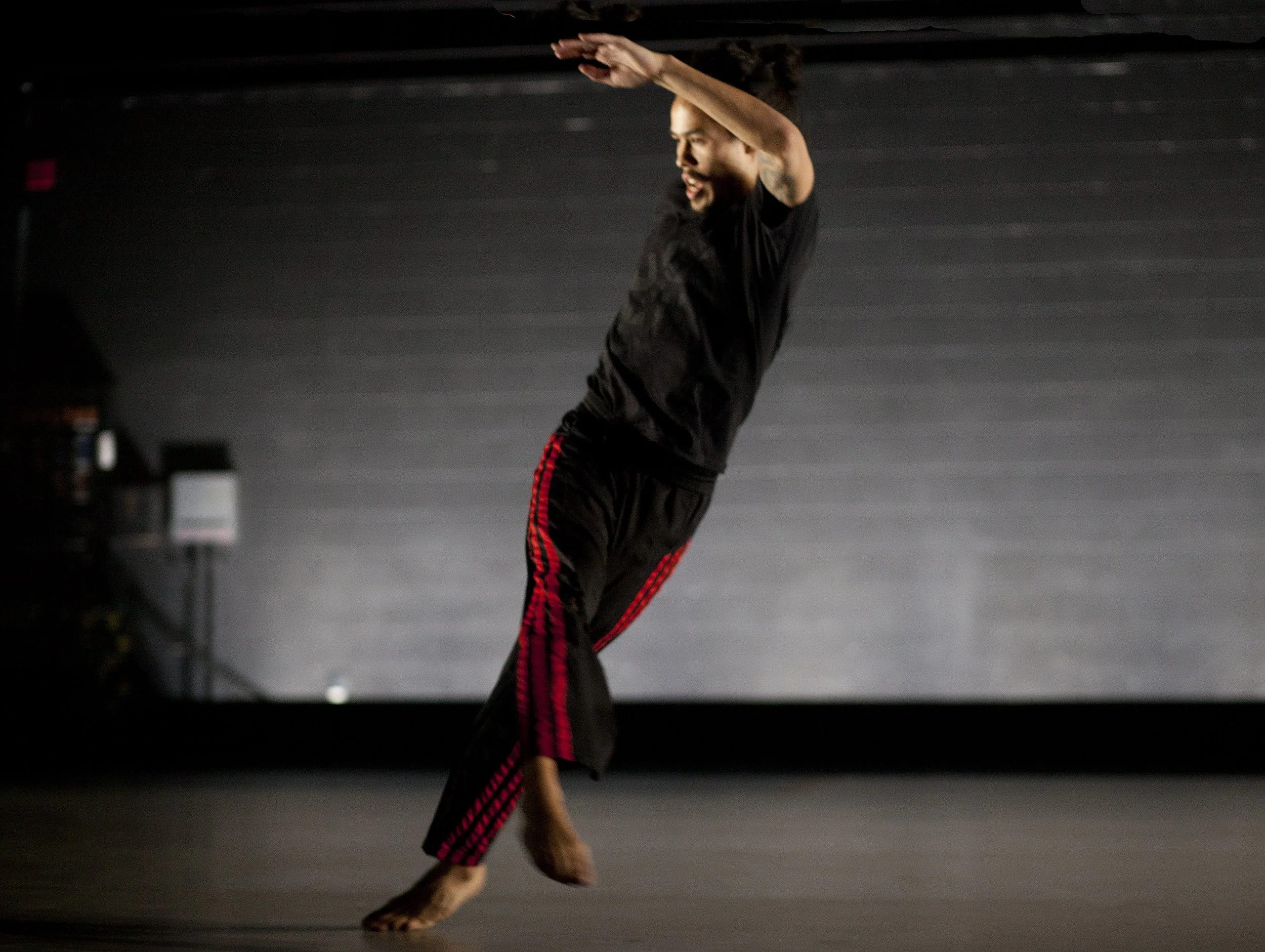
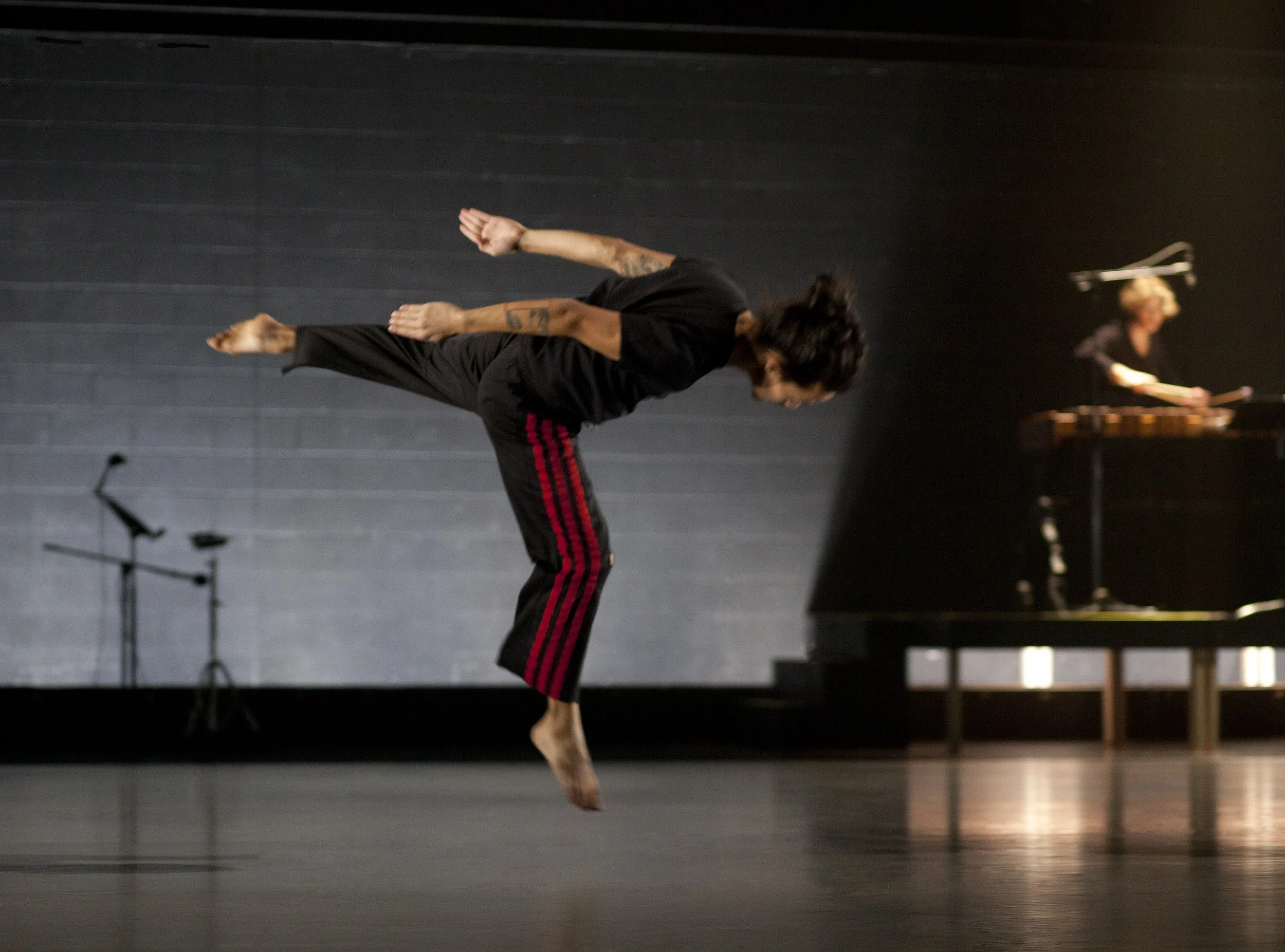
Peggy writes: My extensive work with pianist Andrew Burashko and cellist Shauna Rolston – in addition to commissions from the Toronto Symphony Orchestra and Amici Chamber Ensemble, and collaborations with Arraymusic and Art of Time – had aligned me strongly with the classical and new music scenes in Toronto. And I think it must have been the reputation that I gained through that work that led to a commission from the 2008 Toronto Summer Music Festival. Artistic Director Agnes Grossman paired my choreographic commission with a commissioned score by Christos Hatzis for two extraordinary musicians: cellist Denise Djokic and percussionist Ryan Scott. Agnes had chosen a provocative theme for her 2008 program, titling the festival In the Fire of Conflict. Christos chose to work directly with the title and with rising gun violence in Toronto front of mind, he turned to poet Steven Henry (aka Bugsy H.) for text that was delivered as a spoken word recording, essentially rap. Building on the foundation of that recorded performance, Christos composed a riveting score in which the words gave the impression of igniting the sound of the marimba and cello with an explosive force.
The commission was based on the premise that I both choreograph and perform, and although I knew that I was NOT the right dancer for the part, I found the music deeply affecting and didn’t want to pass up the opportunity. The performance was scheduled for early August, and I was spending the month of July at the Banff Centre staging a work for a company of young ballet dancers. With the dance studios fully booked at the times I was free to work on my own, I ended up choreographing in a weight room in the Centre’s gym, listening to the mock-up of the score on headphones. I had just one rehearsal with the musicians, followed just a couple of hours later by our single performance, but the thrilling charge of dancing with the live music threw me into hyperdrive, and I did my utmost to rise to the challenges of the choreography.
I had always hoped that In the Fire of Conflict could be performed by a male dancer with a wild, gritty edge, and in 2013 I was able to secure the massively talented Benjamin Kamino for performances as part of a concert program by my company. By this point, Christos had made a version of the score for percussion and tape that was in the repertoire of acclaimed Canadian percussionist Beverley Johnston, and by a stroke of luck, her busy touring schedule accommodated the dates of my company’s run perfectly. From their first performance together, Ben and Bev embodied the ultimate interpretation of this fierce and intense piece.

Radio Play (2008)
As we prepare for Peggy Baker Dance Projects’ final stage presentation in September 2022 called Beautiful Renagades - which is a brand new play about dance in 1970s Toronto by Michael Ross Albert - we look back this week to 2008 at another of the company’s original play productions: Radio Play by Denise Clarke.
Peggy writes: Though I’d known her for many years prior, I think that Denise and I began talking about the possibility of a project together following the High Performance Rodeo presentation of a two-part evening by me featuring Doug Varone’s theatrical and highly stylized duet In Thine Eyes (with Larry Hahn), alongside the Sarah Chase dancestory The Disappearance of Right and Left.
Denise is a crazy-talented actor/playwright/director/dancer/choreographer whose genius as a creator, collaborator, performer, and mentor has been honed through her decades of research and realization as part of the renegade theatre company One Yellow Rabbit. Musing upon possible premises for a performance piece, she came up with the story of a modern dancer aged-out of the profession and on the hunt for a new job, and developed a script titled Radio Play. Denise’s program notes capture the spirit of the performance romp: A comedy, a self-reflexive gesture, a fable, an absurdist romance, a lecture-demo. A big change. A bigger fear. In the end it comes down to two people and a table and the future that is waiting. The sound design and composition by fellow rabbit, the late Richard McDowell, provided a tightly-built cue-heavy sonic scaffolding for the action, and Denise’s highly specific plan for lighting was realized by Lee Anholt.
In the end a complicated series of circumstances meant that I had three different performance partners for Radio Play. Larry Hahn premiered with me at Ottawa’s Nouvelle Scene as part of the 2008 Canada Dance festival; actor/playwright Michael Healy did a week run in Toronto as part of Soulpepper’s Young Centre Presents; and finally actor/dancer/playwright/choreographer Conrad Alexandrowicz performed with me at the High Performance Rodeo; each of these brilliant performance partners lining up for the extraordinary opportunity to be on stage in a work written and directed by Denise Clarke. - PB
Winner, 2009 Dora Mavor Moore Award for Outstanding Choreography in a Play or Musical, General Theatre Division: Denise Clarke/Peggy Baker for Radio Play.
“…the performance by Baker serves to remind us of just what great artistry is – and how well it can be displayed in a work as good as this.” Bob Clark, The Calgary Herald


Portal (2008)
This week Peggy reflects on her Dora Mavor Moore awarding-winning solo (Outstanding Performance, Outstanding New Choreography) Portal, a work danced in silence:
Portal is a solo of about 16 minutes that emerged as I poured over a book that was a gift from my husband – Untitled, a collection of the final photographs of Diane Arbus taken between 1969 and 1971 documenting residents of an American institution for neurologically atypical adults. I had always appreciated Arbus’s work, and this book brought together some elements and images that hit an unexpected chord. Mortality was very much front of mind for me at that moment, and I recognized in these photographs intimations of the profound paradoxes of grandeur and fragility, kinship and abandonment, joy and grief that underlie each life.
As the choreography developed it seemed to deliver me to a vantage point from which one could look beyond the known world, and from which there was no turning back. I described myself to lighting designer Marc Parent as being “stranded in an ocean of darkness” and asked him to break the dance into a series of discrete events, each isolated in a different place on the stage. His design for Portal is masterful, as rich and engaging to dance with as music. Performances of Portal over the next five years were deeply satisfying for me, but eventually, it was beyond my grasp.
In the summer of 2021, the Corkin Gallery in Toronto presented an exhibition of work by Diane Arbus and hosted a performance of Portal by the superb Kate Holden. Kate’s rendering of this dance in the presence of Arbus’s photographs was a hugely significant experience for me, and I hold fast to the indelible memory.
“Beginning from clear and simple premises, Baker generates a rich and abundant expression that suggests a thousand and one questions of identity. A great success.” Stephanie Brody, La Presse
“the economy and expressiveness of a fine etching…heroic, mysterious, sublime.”— Michael Crabb, The Toronto Star
Read more about Dian Arbus’ collection Untitled here on nytimes.com


A Woman by a Man (2008)
This week we look at the fourth and final piece created by acclaimed choreographer James Kudelka in the repertoire of Peggy Baker Dance Projects. Captured by photographer Nicholas Minns whilst on tour in Montreal, the work featured outstanding Canadian dancer, Michael Sean Marye as Peggy’s duet partner.
Peggy writes: One of the deep pleasures of my dance life has been working with the formidably gifted and accomplished choreographer James Kudelka. James holds fast to the ambition that each of his dances be a strong, unique, and complete creative statement relevant to and significant within his body of work, and also that each work moves forward the artistry of the dancers as they rise to the unique and considerable technical and expressive challenges. He is ambitious for himself, for those with whom he collaborates, and for the art form itself.
James has confidence in the hard-won wisdom of older dancers (who he approaches without a shred of nostalgia) and after he had accepted my invitation for a duet commission, he also agreed to take on music suggested Andrew Burashko, a fascinating episodic score by Dimitri Shostakovich, his Piano Trio no. 2. The creation of the 30-minute work took place with Larry Hahn as my duet partner, but when a worsening injury proved an insurmountable barrier, Toronto Dance Theatre veteran Michael Sean Marye stepped in to tackle the hugely complex and demanding role. It was privilege and a joy to dance with him – a new performance partner late in my dance life.
A Woman by a Man portrays an older couple whose imbalance of power is so deeply assumed and embedded that it is in no way a source of struggle. When they are together, they are literally attached with the woman slightly behind and to the right of her husband. (If the situation is dire, he pushes her in front of him.) When they are alone, they are each in some way off balance and disoriented. The woman looks as though being on her own is an inconsequential, but delightful, act of subversion. The choreography portrays the rhythm of their daily life and even a little day-in-the-country holiday. But this couple is on the brink on some catastrophe – dreaded but unknown – and whether it takes them both at once, it will surely be a shared demise.
“the audience was won over by the wit and dynamism of the piece.” Penelope Ford, The Dance Current
For more background on Shostakovich’s Piano Trio No. 2 visit ClassicalMusic.com.


Dreaming Awake (2008)
In this week’s post, we look back at the third collaborative project with NY-based dancer and choreographer, Molissa Fenley.
Peggy writes: I was extremely excited to be working with Molissa Fenley again when we set out on the development of Dreaming Awake with a premiere expected early in 2007. I had always taken a huge amount of pleasure in the circuitous choreographic pathways of her dances and the ways in which she connects with musical landmarks, with the dancer navigating the architecture of the sound rather than the phrasing of beats. Dance adrift on an ocean of music.
For Dreaming Awake Molissa had chosen a piano work of the same name by Phillip Glass and used the music – which cycles in repeating loops – twice in a row. It was an interesting coincidence because I had chosen to do the very same thing the previous year with Karen Tanaka’s score for Krishna’s Mouth and I fully appreciated Mo’s desire to double it up.
Choreographically, Molissa set out a series of complicated phrases in what proved to be a first iteration, because before long the phrases were fragmented and rearranged many times over, sometimes doubling back to places on the stage and within the choreographic language that were maddeningly familiar. It felt something like being inside of an architectural construct by Escher and it was quite disorienting. In an early studio showing I became hopelessly lost when I discovered myself at the same intersection in the dance several times in a row, an experience I found completely unnerving.
While I was rehearsing Dreaming Awake I developed chronic pain in the third metatarsal of my right foot. It eventually proved to be a stress fracture, and I learned that it wasn’t going to get better unless I could stop altogether for many weeks. On the other hand, it had been hurting me for months without interfering with what I needed to accomplish, so I decided to go ahead with my planned 5-city tour (titled “3”) thinking that once it was finished I would take time off. Then, just days before leaving for Montreal, doing a simple transfer of weight to my right foot – (you’ve probably seen this coming) – I felt the bone snap and there was no longer any question about when I would stop so that the healing could begin.
Embarking on tour a year later, my foot was up to the physical challenge, but the complexities of finding my way through the labyrinth of steps in this gorgeous dance continued to threaten me with catastrophe. I finally premiered Dreaming Awake in Calgary, but that foot injury marked the beginning of slow shift in my thinking and eventually in my dance practice, one that led me to the role of choreographer of ensemble works.


Krishna’s Mouth (2006)
Having first worked together in 1999 on Words Fail, and then in 2003 on The Transparent Recital, Peggy Baker and cellist Shauna Rolston team up for a third collaboration called Krishna’s Mouth in 2006.
Peggy writes: For an outdoor performance in the Toronto Music Garden on Queen’s Quay West Shauna and I performed a version of The Transparent Recital tailored to the setting, and to complete the program I asked her to open with a work that she would perform without me. Shauna chose Songs of Songs, a gorgeous work for cello and tape by Japanese/American composer Karen Tanaka. I instantly fell in love with this score, its slow spirals of melody tenuously interlacing and then floating apart on the currents of the underlying drone, and with crystalline bells piercing the undulating surface of the sound.
I reached out to Ms. Tanaka immediately to explore the possibility of choreographing a solo to this piece and when it turned out that no recording existed that I might work with she allowed me to arrange a recording session with Shauna. I took the recording with me to Circuit-est in Montreal where a teaching residency included studio time for my own creative work. I have vivid memories of the sound resonating in the spare studio and of the strong pull of the music into an unexpected narrative sphere.
I had been pouring over Annie Dillard’s For the Time Being, a book in which she brings together myths and stories from across epochs and cultures as a way of contemplating how one might come to terms with the underlying existential sorrow of human life. At the time, I had just made the huge and dismantling shift from being my husband’s primary caregiver (he lived with a particularly aggressive and chronic form of multiple sclerosis) to his living in long-term care, and the sadness and guilt attached to this situation was tremendous. One story in Dillard’s book struck a particularly deep and resounding chord for me. It is a story about Lord Krishna as a baby. He’s with his mother, in a garden, and he’s crawling on the ground. He grabs a clod of earth and puts it in his mouth. His mother slaps his hand away, and when she reaches in to clean out the dirt, she sees the entire universe in his mouth. As a caregiver to my husband, I had felt as though he needed me to guide him and keep him safe, but this story turned that idea on its head and proposed him as my teacher, which he surely and far more truly was.
In dancing this work I speak this story out loud, many times. I understand that this story is not mine to tell. But it is a story that I needed to hear, a story that somehow found its way to me, and a story that lives in my body.


The Disappearance of Right and Left (2004)
This week’s work is a truly landmark piece in Peggy’s repertoire. A dancestory created with Sarah Chase, The Disappearance of Right and Left artfully shares stories from Peggy’s family history in a deeply compelling work that speaks to audiences across genres and generations.
Peggy writes: Sarah Chase is a superb artist whose body of work stands as an utterly unique and hugely valuable contribution to the art form. Sarah frames memoir within choreographic structures, combining text and movement in ways that allow the inner life and personal history of the performer to be drawn into alignment with the life experience and empathetic capacities of the audience witnessing the work.
I’m thinking that my own dance with spoken text (a true story, 1997) was made the same year that Sarah created her first dancestory, Muzz. Sarah’s dance was much longer and more complex structurally, but the biggest difference was that Sarah spoke in the first person – unabashedly using the identifier “I” – whereas I spoke in the third person, veiling my relationship to the events I described through the use of the descriptor “the woman”. A studio showing of Muzz by Sarah at Damn Straight on Spadina Avenue in Toronto remains an indelible memory and the power of the work, and of her performance, was absolutely the inspiration for approaching her with the idea of commissioning a work in this style for me.
Six months prior to going into the studio, Sarah assigned me the task of writing two stories representing each year of my life. 51 years old at the time, I needed to excavate 102 stories from my life. Conversations with my parents about my childhood also brought forward stories from their own lives and in the end, Sarah included stories that spanned five generations in my family.
The Disappearance of Right and Left emerged as a work of 45 minutes that was both terrifying and cathartic to perform. It revealed deep connections of experience and learning across the history of my family and allowed me to come to terms with some of the most dismantling turning points in my own life.
Sarah possesses the extraordinary ability to compose and direct performance works centered on personal history without ever veering into the trite or sentimental. Dancestories made for herself, for Marc Boivin, Andrea Nann, and a second work made for me in 2018, (unmoored), comprise a truly remarkable collection of works. PB
Sarah adds this: Peggy was a pivotal teacher, mentor and guide in my life, and I was thrilled and awed to be creating with her in 2004.
I loved how Peggy spoke when she taught, the vivid way she had with language, the colour of joy in her voice, and her inimitable gestures. I knew I wanted to make a work that would allow Peggy to speak stories from her life, to share her rich inner world, and to magnify her extraordinary gestures into a danced language. I wanted to understand her biography and how it had shaped the artist I loved, and if possible to reveal this to an audience.
These 102 stories/memories she assembled sparked deep conversation between us. I remember feeling overwhelmed by the many possible performance directions the material could take. (The first rehearsal we shared for a small audience was over an hour and a half long!) We ended up focussing on 12 stories that were moments when she or a member of her family, experienced a deep shift in perception, which we captured in the title.
To me, Peggy’s dancing contained the big dome of the high prairie skies around Edmonton where she grew up; the open geography of her childhood called forth in her long expressive arms and hands. So part of the beginning of the rehearsal process was creating a dance based on images and experience of being in that landscape. I wanted this to be the ground for the emotional stories that she would be sharing during the piece.
Peggy and I poured over photographs that represented the 12 essential stories we finally chose. In the first performed versions there was a large backdrop that had these double-sided images on it. They swivelled to reveal a full prairie landscape that was on the reverse of the 12 individual story images. I realised, eventually, that the backdrop was actually limiting the performances. Peggy’s gestures were conjuring so deeply the worlds of the stories, that having a literal photographic illustration behind her was an unnecessary distraction. We stopped using the backdrop.
This process was an incredible journey into Peggy’s inner life. It deeply changed the way I thought about creating, and continues to inform my work to this day. SC
“Disappearance is autobiographical…Chase makes full use of Baker’s wonderfully eloquent arms that carve the air in generous sweeping motions or settle momentarily into a detailed sculptural pose.” Michael Crabb , The National Post
The Disappearance of Right and Left is one of the few works in Peggy’s repertoire danced to music with lyrics. For a deep dive on Joni Mitchell’s classic song Amelia, selected by Peggy to feature in this show, visit jonimitchell.com


a way to master silence (2004)
This week we’re back to Peggy creating work for herself as her solo dance practice continues to deepen.
Peggy writes: a way to master silence arose out of a time devoted to movement mediations contemplating the personal world of my dance practice in contrast to the public sphere of my dance life. Through repetition of remembered elements from one day to the next, it took shape as a kind of choreographic mantra – each element of the dance aligned with the influence of an individual central to my personal journey. I wanted to obscure the dance by moving into and out of small zones of light and shadow so that I was just barely visible to the viewer. The late David Morrison created an enigmatic world for me, that felt suspended in both time and space. The sonic world consisted of the sound of my body moving, the sound of the audience watching, and the sounds from outside the theatre that could be heard within it.
The title quotes the composer, writer, and translator Paul Bowles:
There is a way to master silence
Control it curves, inhabit its dark corners
And listen to the hiss of time outside
From the moment that I first read these words I recognized the closest thing I had ever found to a description of my experience inside of dance. When I performed this dance I often used the title as the banner for the concert as well, and for performances in Quebec City and Montreal it translated so potently that I used the title in french: un moyen de maitriser le silence.
“A short yet mysterious solo presents Baker in deliberately fragmented form, viewed dimly in patterned pools of light. The movements we actually see are like pieces of an abstracted jigsaw puzzle that float amorphously in the imagination.”
Michael Crabb / National Post
Visit YouTube to watch a short film and a long film about Paul Bowles.


Heaven (2003)
This week we continue to look at a rich period before and after the turn of the millennium, during which Peggy worked with master choreographers from across Canada and the USA. We’ve arrived at the creation of Heaven for Peggy and pianist Andrew Burashko by award-winning NYC-based choreographer, Doug Varone.
Peggy writes: In 2003 Doug Varone brought together a quartet of dancers for a concert at Jacob’s Pillow titled Short Fictions. Esteemed Limon dancer Nina Watt, Varone Co. veteran Larry Hahn, and I were all in our fifties – with Doug not far behind – all of us baby-boom dance-boomers crossing a fifth decade threshold that had been extraordinarily rare in the previous generation. The program opened with Four Piano Pieces, the first three all Varone masterworks – Nocturn (Chopin), Aperture (Schubert), and Short Story (Rachmaninoff) and it closed with a new work for me with pianist Gabriela Imreh, Heaven, to Cesar Franck’s Prelude, Fugue and Variations.
Heaven is kind of memory play in which the pianist and the dancer each seem to be alone remembering the other. I push against the piano, lean into it and stroke its surfaces. At one point I withdraw the stick holding the piano’s lid open and it slams closed. I sit on the bench back-to-back with the pianist; take their shoulders in my hands and move them; touch their head; lift their hands from keyboard; and even play some of the notes myself. The disruptions to her physical rapport with the piano were, understandably, unsettling to Gabriela, and the tensions provoked became central to the experience of the performance and to the images and associations that arose for the audience.
From the outset, Heaven was intended for my own repertoire, and Doug created it with Andrew Burashko and I. I remember us working in a New York studio with Andrew playing an upright piano with a table set against the side edge of the keyboard so that I could approximate movements against, along, and over it. Andrew was not thrown off at all by the extent and frequency with which the choreography implicated him. The one exception was when I played notes of the music, and due to his precise ear, my touch and timing required on-going coaching.
This work, with its evocations of absence and longing arising from music, holds in it the essence of my experience now, in hearing the music I once lived in as a dancer. - PB
For Facebook people, watch the performance of Heaven in full here on the Art of Time Ensemble Page.
Doug Varone’s Aperture can be seen on Youtube here and Short Story can be viewed here.


The Transparent Recital (2003)
This week we look at a commissioned work from the hugely talented and irreverent Tedd Robinson. The Transparent Recital premiered in Toronto on a program entitled Home, and then toured to St. Mark’s Danspace in New York City, coinciding - purely coincidentally - with one of that city’s worst-ever blizzards, the President’s Day Blizzard in February 2003.
Of Tedd and this work, Peggy writes: Tedd Robinson had provided my very first opportunity for a solo concert in May 1990 as part of the 6th Festival of Canadian Modern Dance, an event he established in Winnipeg in 1985 and which flourished over seven years. He and I are part of the huge cohort of dancers who entered the dance world in the 1970s – both of us Libra Dragons born in 1952 – and nonetheless artists who have pursued very different paths. Tedd’s extraordinary signature as a solo performer in self-made works, and his far-ranging pursuits and accomplishments as a choreographer, artistic director, and mentor have made rich and profound contributions to Canada’s dance milieu over five decades and counting.
An admiring fan of his work, I took the opportunity of commissioning funds from Danspace Project in New York to invite Tedd to create a piece for me with cellist Shauna Rolston. Working with collaborators John Oswald (composer), Caroline O’Brien (costumes) and the late David Morrison (lighting), Tedd created a 30-minute work brimming with both poetry and peculiarity. My own reading of it cast Shauna and I as itinerant performers who each carried with us our childhood fantasies of being on stage. A suitcase I delivered from place to place finally came to rest beside a child-size chair in which I sat to open what turned out to be a victrola. I pulled a 78rpm recording out of a paper sleeve and when the needle was set down it played a recording of Shauna whistling a melody by Bach. After being seated on several of the full-size chairs ranged about the stage, Shauna also eventually arrived on a tiny chair where she took up her childhood instrument – a viola with an end pin – and played the music for the finale scene. Asked by Tedd for a possible title, I suggested The Transparent Recital and it sealed our work. PB
Tedd adds: When Peggy asked me to contribute a work to her repertoire, I was very honoured. We had known each other a long time and our aesthetics were complimentary but different.
I have found a rehearsal tape of the work and I am looking at it now as I write. Peggy is fearless, and what might seem comedic is just so broken and sad in my seeing of it, which I love. She makes this disjointed and non sequential and awkward movement narrative tell so many stories to me. There is posing in front of a microphone as if something important will be said then she walks away, to become a weird creature with thumb horns. Nothing makes sense, it is just so abstract. I would call it body intelligent abstract theatre, as Peggy’s body has so much intelligence.
I enjoyed watching the rehearsal tape so very much. So utterly odd! TR
“Baker shared the stage with one of Canada’s finest cellists, Shauna Rolston… As is so often the case with Tedd Robinson’s work, the ghost of René Magritte and his fellow surrealists seemed to be lurking in the background.” William Littler / The Toronto Star
To meet Tedd in the classic BathTub Bran series, visit YouTube here.


Unfold (2000)
In 2000, the decade-long collaboration between Peggy Baker and Andrew Burashko sees them tackle a major new work suggested by Andrew: Aleksandr Scriabin’s 24 Preludes, Op. 11. Peggy writes:
“Andrew had been proposing this work for some time, and the gift of commissioning funds from Symphony Space in New York and the National Arts Centre in Ottawa – with performance dates that fell just a month apart – provided the perfect opportunity for us to dedicate ourselves to the development of this demanding work.
Like Chopin’s 24 Preludes, Op. 28, (which served as his model), Scriabin composed a short work in each of the major and minor keys of classical western music, and despite this academic premise, his 24 pieces are charged with deep emotion. Some sound as though they are at a loss to complete themselves, while others give the impression that they are about to float apart, combust, collapse inward, or dissolve. A couple of them are as conclusive as a slammed door at the end of a heated argument. Taken as a group they propose what I can only describe as a self-portrait of the composer, and any pianist taking them on must transcend their highly personal specificity and bring a singular interpretation to the score.
I wanted to step up to the score on these same terms, discovering within the style and scope of the music a framework within which to reveal myself with immediacy and authenticity. Ultimately, Unfold offered the audience an intimate experience of Andrew and I as individual artists and as artistic collaborators, but also simply as very different people who have built a deep friendship by bringing our worlds together.
Unfold falls half-way through the 20-year arc of my shared performance life with pianist Andrew Burashko and looking back I see that this was the last of my choreographic works to be created with him; the new dances that followed for he and I were the work of others – Doug Varone, James Kudelka, and Molissa Fenley.” PB
“Baker’s angular, constructivist choreography seems a part of the music, another instrument playing the melancholy themes. Sometimes she dances in silence… Sometimes Burashko plays alone. In those passages the ghost of the music and the after-images of Baker’s movement are ever-present.” - Susan Walker, The Toronto Star
If you’re looking for any information on Aleksandr Scriabin, the Scriabin Association has you covered and then some.


Home (1988, acquired in 2000)
This week we look at another landmark work by American choreographer Doug Varone, the duet Home. Peggy writes:
I no longer remember if Doug Varone suggested the duet Home to me, or if I asked him about the possibility, but certainly by the time I learned it in 2000 I had seen it performed many times and admired it unreservedly. Home brings us into a domestic space shared by a couple, into the interior lives of each of them, and into the complexity of their faltering relationship. Doug scrupulously avoided dance movement within the choreography, instead mining the qualitative nuance of gesture, timing and proximity. The superb music for Home was composed by Dick Connette, a person dear to me as someone closely linked to my personal life in New York throughout the 1980s. The incredible resonance between the music and the choreography achieves a kind of perfection that has made this work timeless. Home is a touchstone in Doug’s repertoire; it is absolutely foundational to his body of work.
I have been fortunate to perform this superb duet many times over 20+ years, including the debut for my company shared with James Kudelka, whose tenderness and humility touched me very deeply; unforgettable performances with Doug at American Dance Festival and Bates Dance Festival; and most frequently with Larry Hahn, whose extraordinary gifts as a performer were honed through his long tenure with Doug Varone and Dancers. PB
Doug adds: There are few works in my repertory as cherished as Home, partly due to the timing of its creation early in my career. The exploration was to craft a simple, unadorned narrative work that employed very little discernible dance vocabulary, embracing only a human everyday quality of movement. This was essential to my trajectory as an artist and the dances that have spilled out of my brain since. I’ve often called the work a theater scene set to music and as the dance has matured with time, I have continued to strip away any further artifice from the choreography. This process began 12 years after the dance was originally made when Peggy acquired the work, and followed discussions we had about pairing it down further to reveal a physical truth that felt authentic to our age as performers. We explored time and gesture with a radically different approach, allowing for the subtlest of movements to speak volumes in ways they hadn’t before. It was a turning point for the dance and perhaps myself as an artist, to understand the great value of re-evaluation. This was not only true of the physical acts that drive the work, but also of the narrative itself to be more truthful and equal in its character’s journeys. Peggy brought a new depth to the work and in doing so asked essential questions of its integrity. That affect has been lasting in a work that has stood the test of time.


loin, très loin (2000)
We’ve reached the next - and largest - collaboration between Paul-André Fortier and Peggy Baker, an epic full-evening solo entitled loin, très loin which translates to far, very far. And that’s exactly where Paul-André took both Peggy and the audience for this work, to a place none of us had previously known existed…
“For several months at a time, during 1998 and 1999, I had the huge privilege and grand adventure of being included in quartet project with Fortier Danse Création in Montreal, La part des anges. The title, (which translates as “the angels’ share”), is a French idiom that refers to the small portion of alcohol lost through the wooden walls of barrels used for fermentation. Perhaps this title was a reference not only to what might be lost in translation, but also to what essence might be captured by bringing together four dancers whose foundation in the dance was dramatically different in each case. In his program note for this work, Paul-André describes me as coming from the world of modern dance; Gioconda Barbuto as being a classical dancer; and Robert Meilleur as a proponent of contemporary dance. I certainly took my own portion during this exceedingly rich and deep experience, and it has continued to work on me over the intervening decades.
Paul-André entered into creation by having each of us learn a recent solo of his, Novembre, and once we all landed with him through this dance he set out through far ranging choreographic experimentation to allow the quartet to arise. His point of view on this was that the dance was waiting in our bodies and in the space and that it would reveal itself through the tasks, proposals, and provocations he set forward. We worked in silence and through a broad range of “atmospheres “ in the studio. Some days were charged with the rigour of copying or improvising, some rode on exuberant joy and hilarity, others were austere and saturated with the weight of significant gestures and choreographic interactions. We worked as a quartet, as re-coupling couples, as soloists. For scenes in which all of us did not dance, the others stood in an upstage centre antechamber as witnesses.
It was thrilling to be on stage with great dance artists in this superb work in Vancouver, Edmonton, Toronto, and Montreal. A year later, Paul-André brought us back together, (with the stellar Lisa Kovacs rather than Gioconda, who was now a dancer with NDT3) and we remounted the dance during a 3-week residency in Angers, France followed by performances in Bordeaux. One night, returning to the hotel from the theatre, Paul-André and I improvised together as we crossed a bridge, and it suddenly hit me very hard how much I was going to miss being a part of his work and world. The next day I gathered up my courage and asked Paul-André if he would consider allowing me to perform a program made up of his short works – Non Coupable, Novembre (which had struck a deep chord in me), my duet from La parts des anges with Robert Meilleur, plus something new for me. When Paul-André’s eyes widened and he said quite simply “Non”, I felt the terrible thud of refusal, and the humiliation of having stupidly trespassed beyond the scope of our relationship. And then he immediately said, “I prefer to make you a full-evening solo”. Within a year, he had done just that.
I wrote a program note for this dance that has become more fully realized with each passing year:
I have become a very different dancer, even in some way a reinvented woman, by virtue of being set in motion by Paul-André Fortier. It is as if his dance asks, “What if this had been the case? Would you not now have become someone else?” So embodying a rewritten history, I navigate a new fate.” PB
Paul André adds: “This piece was created extremely quickly. In fact Peggy struggled to remember all the material I was creating, so swiftly did the ideas come tumbling out. The choreography, costuming, lighting and the music all worked in tandem, feeding Peggy’s interpretation. It was the most demanding solo Peggy had ever performed. The multitude of performances at Montreal’s Agora de la danse seemed as daunting as climbing Mount Everest. And what a magnificent ascent!”
“It would be impossible to overstate the gravitas of this work… The revolutionary ethos of Fortier’s own early years…are summoned forth here by the acid guitar solos of Gaetan Lebœuf’s original score.” Michael Scott / The Vancouver Sun
Watch a short film made about Paul-André Fortier, released by the National Film Board here on the occasion of the 2012 Governor-General’s Award for Lifetime Achievement in the Arts.
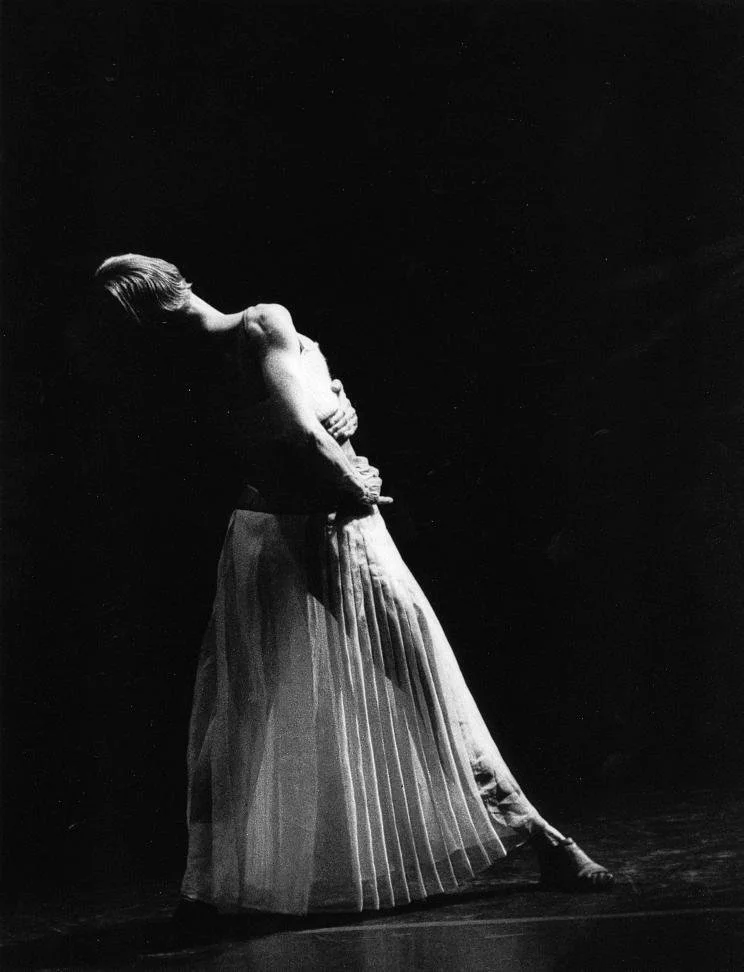
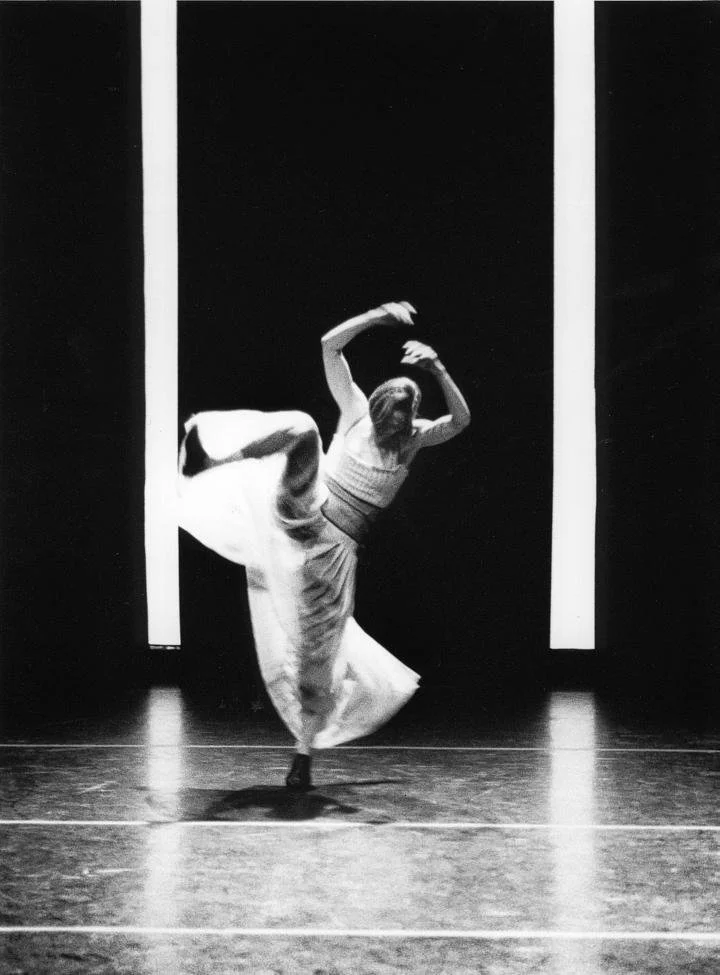
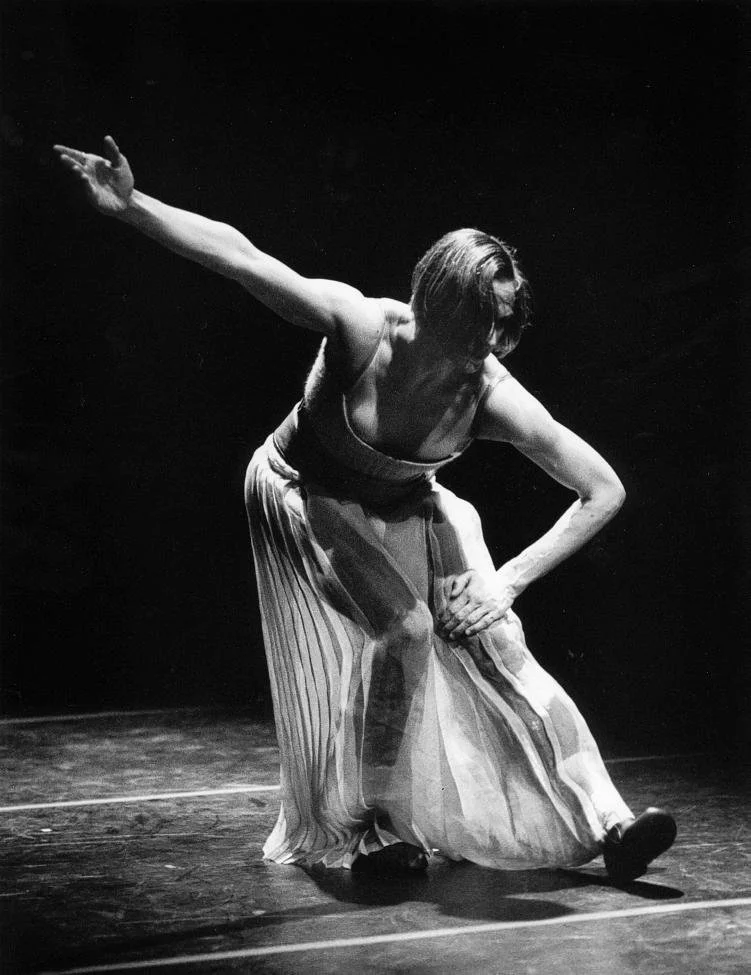
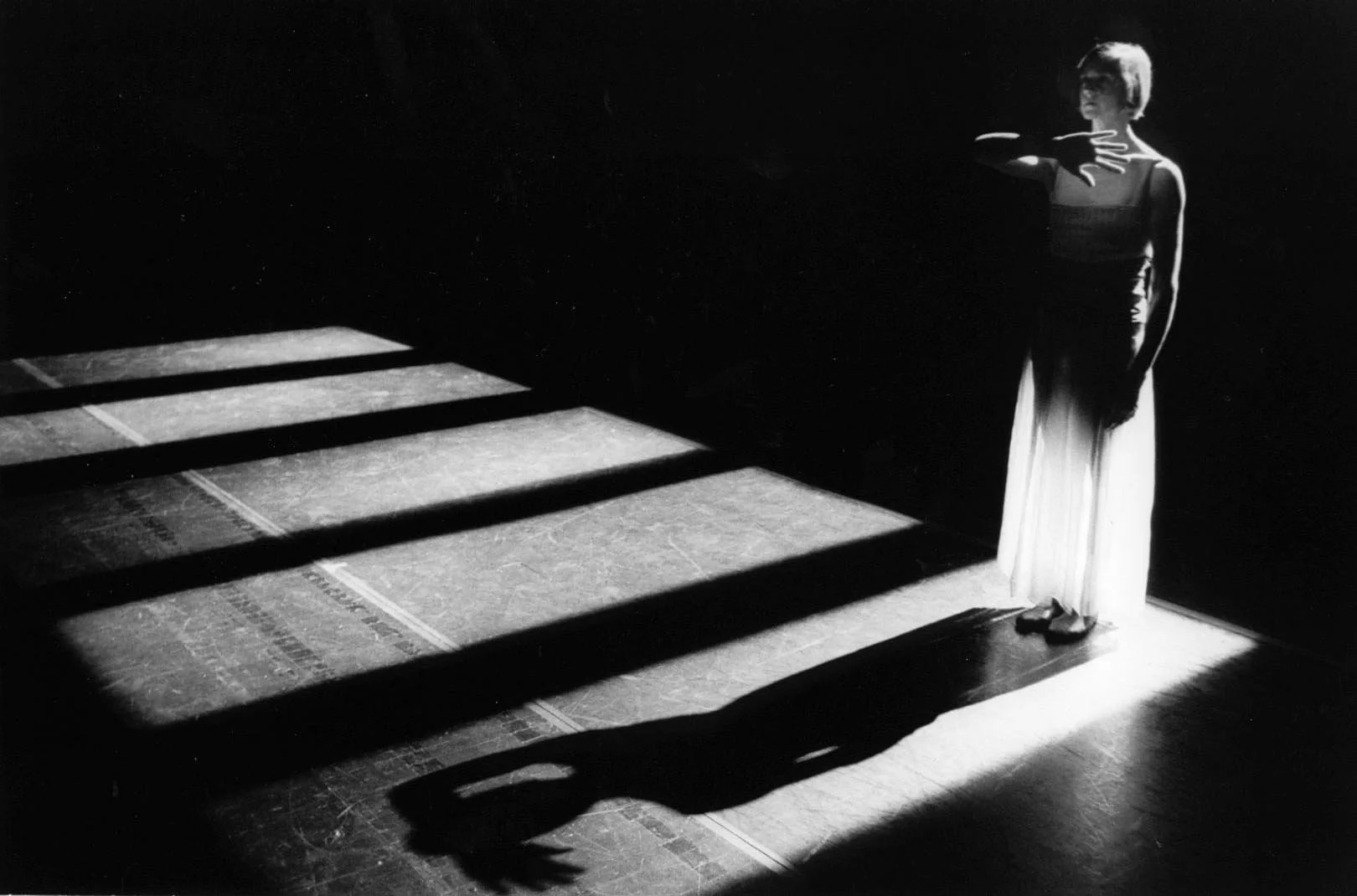
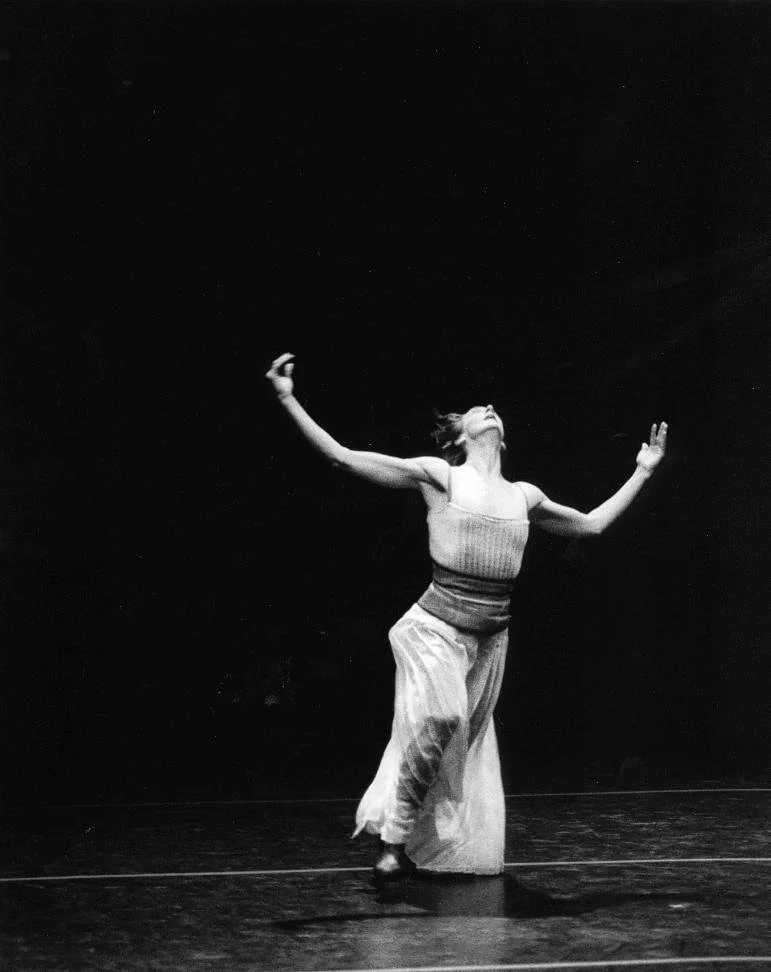
One of the most daunting challenges I have encountered in my dance life was an hour-long solo, loin, trés loin, created for me by Paul-André Fortier. It went absolutely against the grain of my technique and physicality. I couldn’t tell without the feedback of the rehearsal director, Ginelle Chagnon, whether I was inside or outside the aesthetic. The dancing was grueling to the point that I could barely get through it, and it left me thoroughly battered and spent. This was a solo made expressly for me, and I was terrified that I would humiliate myself as a performer and fail Paul-André as a creator. But some extraordinary things can happen when we are thrown beyond the outer reaches of our comfort zone and we are required to embody a physicality far removed from the self-image we like to affirm. Our strengths and weaknesses are laid bare; we are forced to deal with things we’d rather avoid; we see, and are seen, through a new lens; everything is at stake, so now there is something of real interest and importance to share. My program note for loin, trés loin was a thank you note to the choreographer for helping me to move beyond myself and toward something higher:
I have become a very different dancer, even in some way a reinvented woman, by virtue of being set in motion by Paul-André Fortier. It is as if his dance asks, “What if this had been the case? Would you not now have become someone else?” So embodying a rewritten history, I navigate a new fate.
As dancers, we are shaped by the works we perform, and that impact goes beyond our professional lives, directly to the personal sphere. As choreographers, we express ourselves on a kinesthetic and aesthetic level, but that expression is a direct translation of our imaginative, experiential, and intellectual lives, our basic humanity.

Cirrus (1997/2000)
A faculty member of The Juilliard School since 1995, Irene Dowd has been a foundational presence in Peggy Baker’s dance life, providing neuromuscular training and creating Cirrus on and for Peggy in 1997. Peggy explains:
“It’s beautiful to think back to this brief and exquisite dance, choreographed by my dear friend and cherished mentor Irene Dowd. Beginning in 1985 – and continuing over the next two decades – Irene guided me in discovering the inner landscape of my body, in all its mystery and magnificence, through an evolving movement practice grounded in functional anatomy.
In 1997 we shifted our focus to a dance choreographed for me by Irene. In a recent exchange of memories around our process, Irene remembers being under the sway of two important paintings by her late husband, Charles Stokes – the dazzling and rhapsodic Perpetua (which he was just completing) and the labyrinthine Inner Temple (which was newly underway).
Irene titled the dance Cirrus, as she felt the definition – “a tendril, a long thread-like organ by which a plant climbs; a light fleecy cloud at a high elevation” – sounded as though it was describing the movement. We had created in silence, but once the work was completed, I suggested dancing it with a John Cage work titled Dream. I didn’t have a chance to perform Cirrus until 2000, when it premiered as part of an evening titled Interior View. Irene allowed me to finish her dance by reaching my hand to the piano on the last note. No photographs of this dance exist, so it remains a treasured memory.” PB
To see an example of Irene’s approach to teaching functional anatomy through choreography, visit her website here.
To learn more about artist Charles Stokes, visit SeattleArtResource here.

Photo of Irene Dowd by Matthew Karas.

In Thine Eyes (1996, acquired 1999)
This week we are looking at an exceptional work from acclaimed choreographer Doug Varone, Peggy’s fellow performer from her years with the Lar Lubovitch Dance Company. Doug left Lar’s company in 1986 and was soon at the helm of his own, Doug Varone and Dancers, based in New York.
“In 1996 Doug organized his company as male/female couples and, shifting the primary cast with every rehearsal day, created a duet titled In Thine Eyes. The highly stylized movement he invented called on the dancers to move in stop-action, so that each moment in the choreography created a tableau. He arranged the space geometrically, with the dancers moving along strictly delineated pathways, corridors that eventually brought them together, throwing them directly into one another’s spheres and – with all the frission of a chemical reaction – into a highly stylised series of discrete choreographic episodes. Doug had chosen as music, a selection of tracks from Michael Nyman’s Noises, Sounds and Sweet Airs, originally composed for an opera-ballet, La Princesse de Milan, based on Shakespeare’s The Tempest. The episodic nature of the music – with male and female voices delivering a libretto that became abstracted because of the displacement of the narrative – created a sense that the man and woman dancing were motivated by impulses they did not comprehend while enacting rituals whose origins had been lost. But certainly, the two figures in the dance are driven by all the magnetism, vagaries, and intensity of love and lust.
Within a year of its premier, and before I had seen the work in performance, Doug contacted me to say that he had a dance that I should learn. The staging was undertaken by Gwen Welliver and Larry Hahn, members of Doug Varone and Dancers who had both been involved in the creation. Though I was preparing to perform with Doug, Larry was my partner throughout the rehearsal process, and Doug and I had only danced the work together twice prior to the opening night of my April 1999 Toronto season. Doug is an electrifying performer and being on stage with him in this magnificent work is one of the most profound experiences of my dance life. Every aspect of this work aligns with the highly distinctive aesthetic established by the choreography. Doug had envisioned the lighting, (realized by David Ferri), and it was both stunningly beautiful and devilishly tricky to dance in. Lynn Steincamp’s costumes were simple and perfect – square cut, but in flowing fabrics that revealed the body.
Doug joined me for performances at the National Arts Centre in Ottawa in 2001 and in 2006 the magnificent Larry Hahn and I did a five-city Canadian tour.
Oh, how I LOVE this dance! Doug is a master choreographer; his signature as a creator is unique and indelible. Eventually, my repertoire included five Varone duets: The Volpe Sisters, In Thine Eyes, Home, Heaven and armour. Each of them is a jewel.” PB
"This is dance at its very best, performed by two consummate artists, using the language of movement to trigger an emotional recognition that words could never achieve." Michael Crabb, The National Post
Listen to Richard Burton recite John Donne’s poem The Good Morrow, from which the title of this dance is sourced, here on Youtube.


